Guide
How to practice interview answers out loud with AI
Updated 2026-11-18 · a 20-minute routine · with a real report from a test run
Pick the job you want, let a voice AI interviewer ask you the questions that job would get, and answer out loud the way you would on the call. Then read a report that quotes your own words back to you and says what to fix, and run it again until the weak spots stop showing up.
Three mocks free with an email sign-up, no card. Runs in the browser, nothing to install.
For live interviews: the FlexQ interview copilot for Mac or Windows, 30 free live minutes.
The FlexQ mock interviewer does this in your browser. It builds the interview from the job description and, if you add it, your résumé; it follows up when an answer is thin; and it ends with a report scored out of 10. Three mock interviews are free with an email sign-up, no card. You can practice in English, Russian or Spanish.
Why out loud, and not in your head
Reading an answer and saying it are different skills. Silent rehearsal skips exactly the parts that break under pressure: the first sentence, the number you can't quite recall, the story that runs past two minutes, the "we" that hides what you did yourself. Interviewers can only grade what they hear.
A list of questions also never pushes back. In a real interview the second question is usually a follow-up on your first answer: "what did that cost?", "what would you do differently?", "and what did you do?". Practicing with something that follows up is how you find out which of your stories hold up to a second question.
A 20-minute practice routine
- Minutes 0 to 3: set it up. Paste the job description for a role you are actually applying to (at least a couple of sentences from the posting). Add your résumé as text or a PDF or DOCX file if you want questions about your own experience; without it the interviewer works from the job description alone. Choose the format: an experience deep-dive or a recruiter screen, both by voice. A coding round with a live editor also exists and takes about 30 minutes, so keep it for a separate session. Then pick who asks: Maya is warm with an honest bar, Viktor is a cold bar-raiser who wants numbers, and Sera is charming and relentless with follow-ups.
- Minutes 3 to 15: do the interview. Answer out loud, as you would on the call. Don't pause to write notes. Keep stories to 60 to 90 seconds, say "I" for what you did, and put the number in the first half of the answer, not the last line. When you don't know something, say how you would find out instead of stopping at "I'm not sure" (the test run below shows what that costs). Six to eight answers are enough for a useful report; end with "End interview and get my report".
- Minutes 15 to 20: read the report and redo one answer. Read the critical gaps and the worst moment first, then "What a strong answer sounds like". Pick the weakest answer and say a better version out loud twice, once now and once the next day. Next session, start from your history with the same résumé and job description, and compare the score with the last run.
Twenty minutes, three or four times before the interview, does more than one long session the night before. The point of the second and third runs is not a higher number; it is hearing yourself give the fixed answer without reaching for it.
What the report checks
The report is written by a model under fixed rules in the mock interviewer's code. Each section has one job:
| Section | What it holds |
|---|---|
| Score and verdict | A score out of 10 and one sentence on why. 8 to 10 is kept for answers that were quantified and STAR-structured, with concrete numbers and clear ownership. 7 is solid with real gaps, 5 to 6 means notable weaknesses that would likely not advance at a competitive bar, and 1 to 4 would not advance. Most interviews land between 5 and 7. |
| Strengths | Two or three moments that worked, each with a quote of what you said. |
| Critical gaps | At least two. Each names the gap, quotes the words that exposed it, and says why it costs you. |
| Worst moment | The single weakest exchange, quoted, with what went wrong and what a strong answer would have done. |
| Missed opportunities | Things you could have said and didn't, taken from your résumé. |
| What to fix | Two or three concrete actions for next time, each tied to a gap. |
| What a strong answer sounds like | Your one or two weakest answers rewritten in the first person, 60 to 120 words, built only from facts on your résumé. |
Four rules shape the wording. Evidence: every critical gap and the worst moment must quote your actual words; a claim it can't quote, it doesn't make. Grounding: it judges only what is in the transcript; your résumé is used for missed opportunities, never as proof of what you said. No generic advice: nothing like "be more confident" that could apply to any interview. No flattery: phrases like "great job" and "nailed it" are banned, and praise has to be earned by a quote.
Before you see the report, an automatic check rejects it if the score is missing, a section is skipped, there are fewer than two critical gaps, or fewer than two quotes of your words, or a flattery phrase slipped in. The model then rewrites it, up to two more times; a report that still fails is shown marked "unvalidated". If the interview was too short to judge, you get "Too short to judge" instead of a score.
A real example: one test run, scored 6/10
On 2026-11-11 we ran one mock interview on a FlexQ test account, not a real user's. The candidate is made up: "Jordan Lee", a frontend engineer with three years at a logistics software company and two at an agency, applying for a made-up Senior Frontend Engineer job. Maya interviewed, in English, in the experience deep-dive. We typed the ten answers instead of speaking them so the run is easy to repeat; the report works from the transcript either way. Three answers were weak on purpose: a vague first pass at debugging a production freeze, "I set up a few meetings" on design-system pushback, and "I'm not sure" on a question about slow-connection performance.
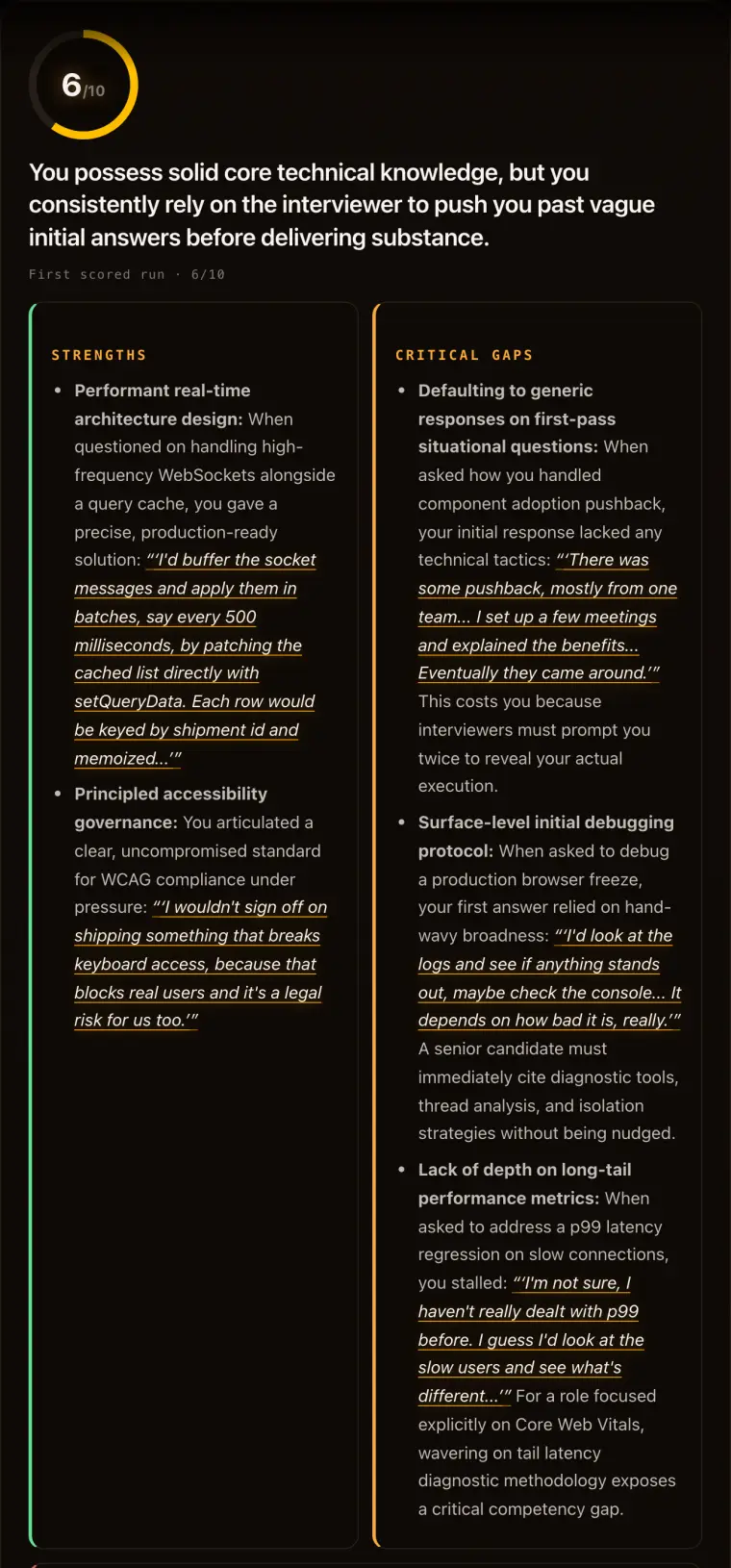
The verdict
"You possess solid core technical knowledge, but you consistently rely on the interviewer to push you past vague initial answers before delivering substance."
That is the pattern the run was built to show. Twice the interviewer had to ask again before the useful answer came out, and the report counted that against the score even though the second answers were good.
A critical gap, with the quote that exposed it
"When asked to debug a production browser freeze, your first answer relied on hand-wavy broadness: 'I'd look at the logs and see if anything stands out, maybe check the console... It depends on how bad it is, really.' A senior candidate must immediately cite diagnostic tools, thread analysis, and isolation strategies without being nudged."
A missed opportunity from the résumé
"Your résumé notes closing 41 WCAG 2.1 AA audit issues at Brightline. When discussing accessibility trade-offs, you omitted this concrete impact metric."
What a strong answer sounds like
For the debugging question, the report rewrote the answer from the candidate's own material:
"I would immediately check our error tracker for the user agent, then put the new map view behind a feature flag to disable it for that customer while preserving their service. Next, I would reproduce the freeze using Chrome DevTools or Firefox Profiler to inspect main thread execution for long tasks and heavy marker rendering stacks. …"
The takeaway for the next run is short: lead with the tool and the number on the first try, and when a question is outside your experience, walk through how you would investigate it. That is a fix you can rehearse in five minutes, which is the point of the exercise.
Mistakes that waste practice time
- Typing instead of talking. Typing is fine for drafting a story. The rehearsal is saying it.
- Practicing for a generic job. The questions come from the job description, so paste the one you are applying to, not a placeholder.
- Rerunning for a higher number. If you change nothing between runs, the score tells you nothing. Fix one gap per run.
- Memorizing the strong answer. It is built from your facts, but it is a draft. Keep the structure and the numbers and say it in your own words.
For the questions themselves, see interview questions by role, for example the frontend developer questions used for this test run, and how to answer "Tell me about yourself".
Practice it now, free
Three mock interviews are free with an email sign-up, no card. Each one can run up to 45 minutes and ends with the full scored report.
On the real call
FlexQ also has a live copilot for macOS and Windows. Add your résumé and the job description, and when a question lands it shows a short cue from your own experience, so you answer in your own words instead of blanking. Your first 30 live minutes are free.
For live interviews: the FlexQ interview copilot for Mac or Windows, 30 free live minutes.
FAQ
Is the AI mock interview free?
Yes. Three mock interviews are free with an email sign-up (a one-time code), no card. Each one can run up to 45 minutes and ends with the full scored report.
Do I need to install anything?
No. The mock interview runs in your browser and needs microphone access for the spoken interview. Some in-app browsers block the microphone: open the page in Safari or Chrome, or type your answers instead.
Which languages can I practice in?
English, Russian and Spanish. You pick the interview language before you start, and it stays the same for the whole interview.
How is this different from rehearsing with ChatGPT?
A chat thread mostly grades text you typed and had time to edit, and it answers whatever you ask it. The mock interviewer plans its questions from the job description and your résumé, asks them out loud, follows up when an answer is thin, and ends with a scored report that quotes your own words. Typing answers to a chatbot helps you draft; saying them to an interviewer that pushes back is the rehearsal.
How long is a mock interview?
A conversational interview takes about 15 minutes on average and a coding interview about 30. A session can run up to 45 minutes, and you can end it whenever you want the report. If it was too short to judge, the report says so instead of giving a score.
What happens after the three free mock interviews?
Your reports stay in your history. To keep practicing, Monthly ($49/month) and the 90-day Pass ($99 one-time) both include mock practice, up to 30 sessions a month and 45 minutes each, plus live copilot hours in the FlexQ desktop app: 12 a month on Monthly, 25 on the Pass.
More guides
All guides · Video interview setup checklist · Interview nerves and blanking · Interview questions by role · Pricing