Guide · work calls
Architecture decision records your team and your agent can answer from
An architecture decision record (ADR) is a short document that captures one decision: the context, what was chosen, what was rejected and why. The point is that six weeks later someone asks "why did we pick X?" and the answer is written down. With coding agents writing much of the code, ADRs matter more: the agent knows the reasons, and you get asked about them on calls.
Updated 2026-11-23 · tested with Claude Code and Codex
What an ADR is (and isn't)
One decision per record. Records are numbered and immutable once accepted: when a decision changes, a new ADR supersedes the old one instead of editing it. A proposal isn't a decision until it's marked Accepted.
ADR template
# ADR-0007: Use NATS instead of Kafka for event delivery
Status: Accepted (2026-09-14)   Supersedes: none
Owner: <name>

## Context
What problem forced a decision. Numbers that matter, with units.

## Decision
What we chose, in one sentence.

## Options considered
- Option A: why rejected (cost, ops load, a limit, with numbers)
- Option B: why rejected

## Consequences
What gets easier, what gets harder, what we must watch.

## Sources
Links to benchmarks, quotes, tickets.
Example from our demo project, made-up data.
Decision log template
For teams that won't write full ADRs, a decision log keeps one row per decision. Two example rows from our demo project, made-up data:
| # | Date | Decision | Why (with numbers) | Rejected | Owner | Status | Link |
|---|---|---|---|---|---|---|---|
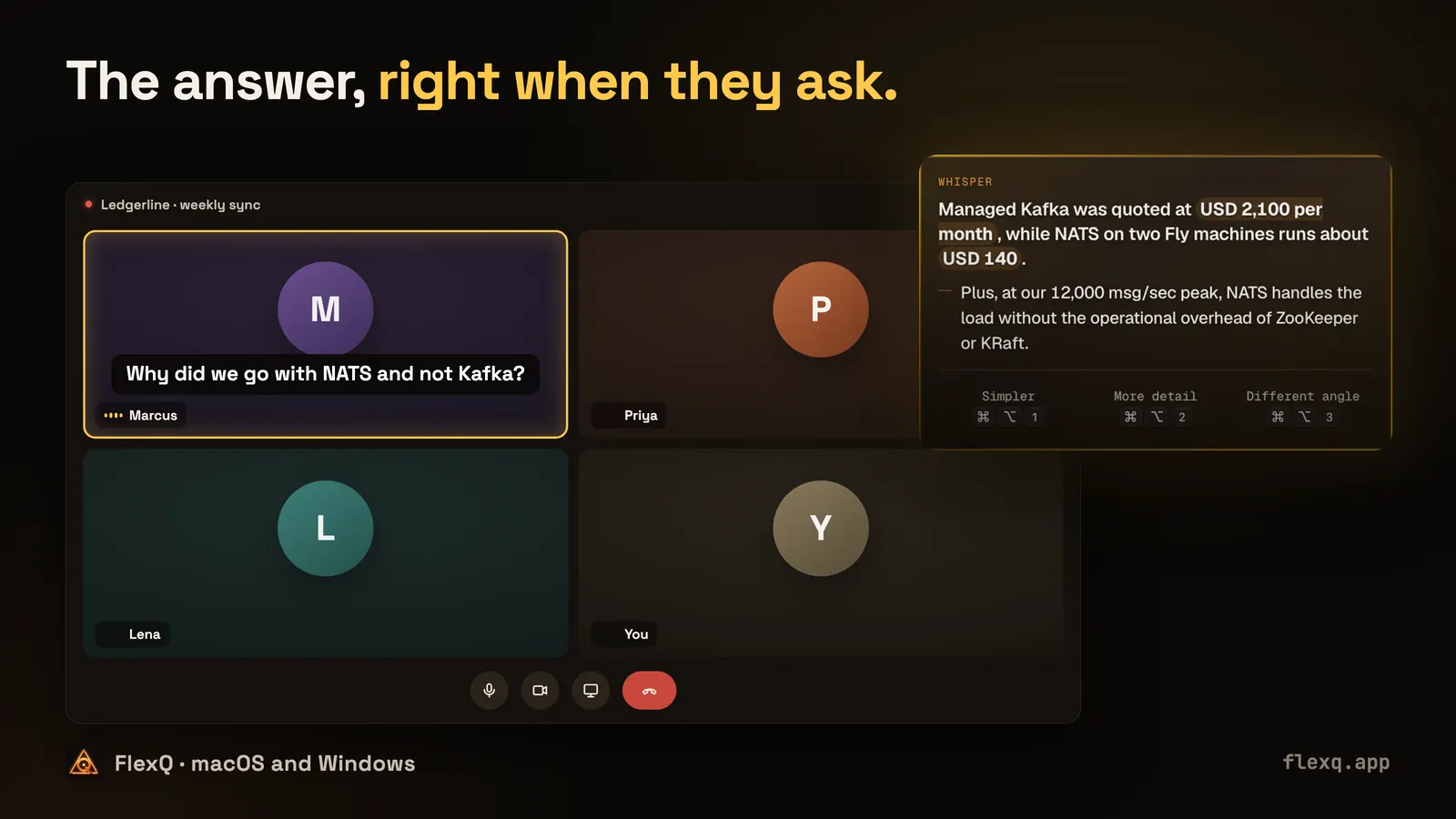
| 7 | 2026-09-14 | NATS for event delivery | Managed Kafka quoted at USD 2,100/month vs about USD 140 for NATS on two Fly machines; handles the 12,000 msg/sec peak without ZooKeeper/KRaft overhead | Kafka | Diego | Accepted | docs/adr/0007-events.md |
| 4 | 2026-08-02 | Access tokens live 15 minutes; refresh tokens 30 days, rotated on every use | A stolen access token is useful for 15 minutes at most; rotation flags a reused refresh token | Long-lived sessions | Priya | Accepted | docs/adr/0004-auth.md |
Write ADRs so they answer questions on calls
- Keep the exact numbers with units. "Cheaper" is not an answer; "USD 2,100 vs USD 140 per month" is (demo numbers).
- Write every reason, not just the main one.
- Mark the status plainly (Proposed / Accepted / Superseded), so nobody presents a proposal as a decision.
- Name an owner.
- Keep conflicts visible: if the code does something the ADR doesn't say, record both.
Put the key values from your ADRs in one place too: put the key values in a facts file.
Let your coding agent write and keep them
Claude Code or Codex can draft an ADR from a PR discussion or a call. Ask it to copy numbers verbatim and never round. After a call, have it propose ADR changes as a diff for you to approve. More on rules for the agent in the CLAUDE.md / AGENTS.md guide.
Using ADRs live
FlexQ's Prepare step has your agent pull decisions and their reasons from ADRs into a facts file. When someone asks "why NATS?" on a call, the cue shows the reason and the numbers from the record. See the AI meeting assistant or FlexQ for work calls.
Download FlexQ for macOS or Windows. How it handles your files is set out in the privacy policy.
FAQ
What's the difference between an ADR and a design doc?
A design doc explores a problem and proposes a solution before the work starts; an ADR records one decision that was made and why. One design doc can lead to several ADRs, and each ADR stays short: context, decision, options considered, consequences.
Where should ADRs live?
In the repo, in docs/adr/, one numbered file per decision. There they are versioned and reviewed with the code, and your coding agent can read them.
Who writes ADRs?
Whoever made or drove the decision, usually the engineer or tech lead who owns that area. Every record names an owner, and the team reviews it like code.
Should you edit an accepted ADR?
No; supersede it. When the decision changes, write a new ADR and mark the old one Superseded with a link to the new one.
Can an AI agent write ADRs?
Yes, as drafts a person accepts. Claude Code or Codex can draft an ADR from a pull request discussion or call notes; ask it to copy numbers verbatim, then read it and mark it Accepted yourself.
More
FlexQ for work calls · AI meeting assistant for work calls · CLAUDE.md / AGENTS.md guide · Project facts file template · All guides · Download FlexQ