Guide · work calls
Make your CLAUDE.md / AGENTS.md answer questions on calls
Your CLAUDE.md tells a coding agent how to work. To answer questions on a call you need a second file next to it: a facts file with exact values, dates, owners and decisions, each with its source. Have the agent write it, keep it current after every call, and read it before you talk.
Updated 2026-11-22 · tested with Claude Code and Codex
The problem: the agent shipped the details, you get the questions
When a coding agent writes most of the code, the decision records and the status notes, the project grows faster than anyone can memorize it. You keep the big picture. The details live in the repository. Then a client asks on a call why you picked NATS over Kafka, or a teammate asks how long access tokens live, and the answer is sitting in a file the agent wrote three weeks ago. "Let me check and get back to you" works once. On the fifth question it costs trust.
The fix is not a better memory. It is a file written for that moment: short, exact, and current.
What CLAUDE.md and AGENTS.md are for today
CLAUDE.md (read by Claude Code) and AGENTS.md (read by Codex and a growing list of other agents) are instructions. A good one says how to build and test, which conventions to follow, what never to touch, and where the longer docs live. The Claude Code documentation and the AGENTS.md convention both push you to keep these files short, because everything in them is loaded into every session.
That makes them a poor place for project facts. "Use pnpm, run the tests one file at a time" belongs there. "Access tokens live 15 minutes (docs/adr/0004-auth.md)" doesn't: it is not an instruction, it changes, and a person on a call needs it faster than they can scroll a list of build rules. Keep the two apart and link the facts file from CLAUDE.md in one line, so the agent knows it exists and keeps it current.
What a facts file needs
This is context engineering in its plainest form: deciding what goes in front of a model, or a person, at the moment they need it. A facts file is a lookup sheet, not a summary. One fact per line, grouped under short headings, and each line ends with its source. What to put in it:
- Exact values with their units. Limits, timeouts, retry schedules, sizes, versions. Copied, never rounded: "15 minutes", not "short-lived".
- Dates. Releases, deadlines, audit windows, what shipped when and what comes next.
- Owners. Who owns which service, review or deadline.
- Endpoints and interfaces. Method and exact path, queue and topic names, config keys, the main modules.
- Every reason behind each decision. What was chosen, what was rejected and all the stated reasons, copied from the decision record. A rationale shortened to one phrase is the first thing you can't defend on a call.
- A source on every line. A file path, with a heading or line when it helps, or the meeting where it was decided.
- Conflicts kept, not merged. If the roadmap says one date and the status file another, write both with their sources and mark the conflict. A merged line hides the question you will be asked.
- "In code:" lines. Some values exist only in code: a constant, a default, a feature flag. Write the value, the name of the constant and the file, and start the line with "In code:", so nobody confuses what the code does today with what a document planned.
Here is a short example from Ledgerline, a demo project we use for testing. The project and all its data are made up.
# Ledgerline facts (made-up demo project)

## Decisions
- Event bus: NATS, not Kafka. Managed Kafka was quoted at USD 2,100 per month; NATS on two Fly machines runs about USD 140. NATS also avoids running ZooKeeper or KRaft. Status: accepted. (docs/adr/0002-event-bus.md)

## Auth
- Access tokens live 15 minutes. (docs/adr/0004-auth.md, "Token lifetime")
- Refresh tokens are valid for 30 days and rotate on every use. (docs/adr/0004-auth.md)
- In code: ACCESS_TOKEN_TTL = 900 in src/auth/tokens.ts, the same 15 minutes in seconds.

## Compliance
- SOC 2 Type I audit window starts 2026-01-12, platform Vanta. (docs/status.md)
- Conflict: docs/roadmap.md says the window starts in February; docs/status.md (newer) says 2026-01-12.

## Owners
- Security review of the upload flow: Diego, due Friday 2026-11-20. (meeting 2026-11-13, decided on the call)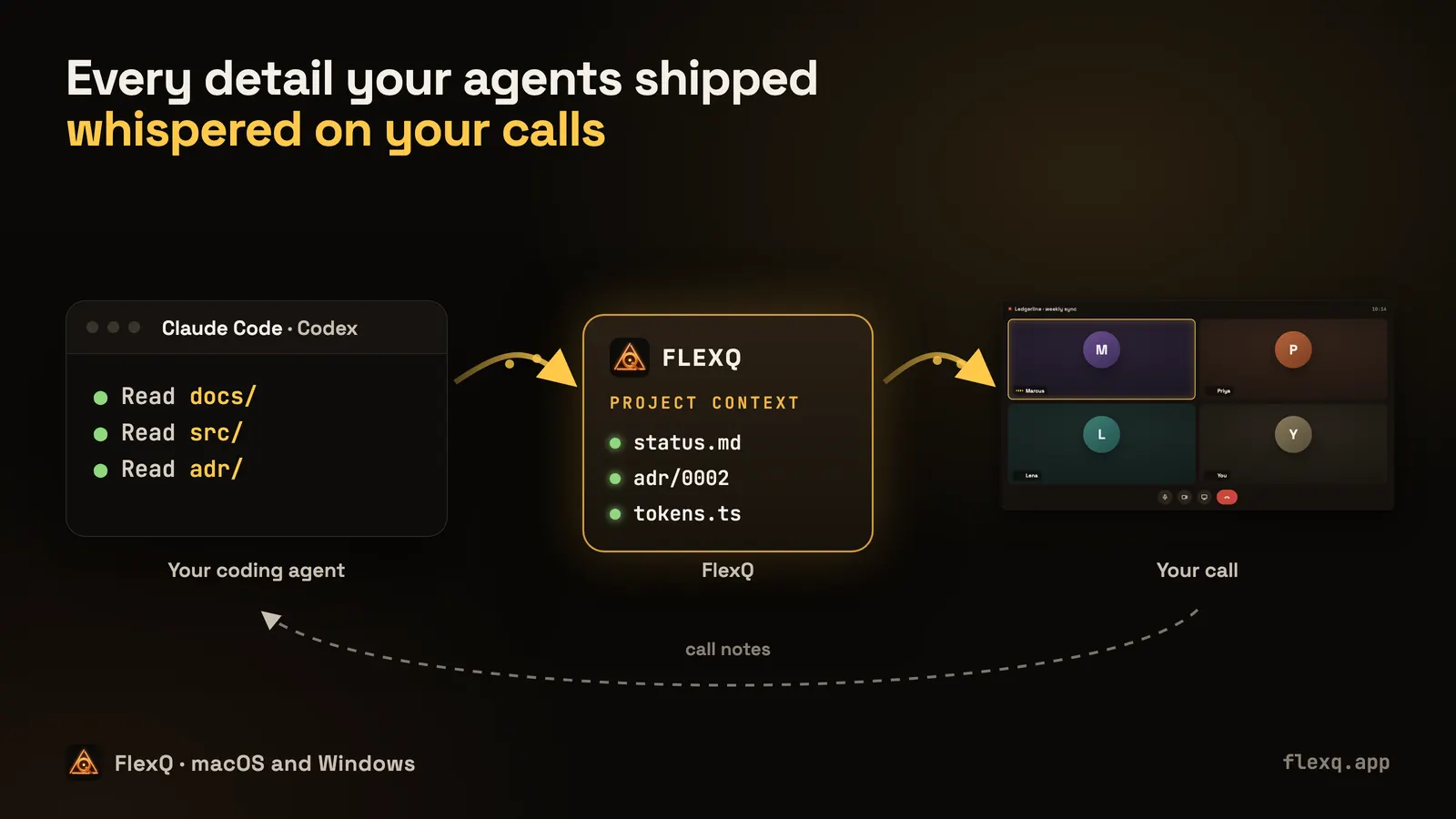
How to have Claude Code or Codex write it
You don't write this file by hand. Open a Claude Code or Codex session in the project folder and give it rules that stop the usual failure: a fluent summary that drops the exact numbers. These Claude Code tips work the same in the Codex CLI. A condensed version of the instruction we use:
Read the README, everything under docs/ (decision records, roadmap,
status, changelog, runbooks), then the source code.

Write context/00-facts.md. It is a lookup sheet, not a summary.
One fact per line, grouped under short headings, each line ending
with its source in parentheses.

- Copy facts VERBATIM. Never round, convert, translate, rename or
  paraphrase a number, date, name, path, endpoint or status.
- Never invent a value, and never add one you worked out yourself
  (a total, a duration, a difference).
- If two sources disagree, record both with their sources and mark
  the conflict.
- A fact the source states plainly is written plainly. Your own
  doubts go to "Open questions" in a separate brief, not here.
- For a decision, copy what was chosen, what was rejected and EVERY
  stated reason. Do not shorten a rationale to one phrase.
- Values that exist only in code start with "In code:" and name
  the constant and the file.
- Keep proposals apart from decisions.
- Never write credentials, tokens, keys or passwords.

Then reread each source and confirm every number, date, name and
path matches it character for character. Tell me what you could
not verify.
Two rules do most of the work. "Copy verbatim, never round" keeps the values you will quote. "A source on every line" lets you check a surprising line in seconds and tells the agent where to look when it refreshes the file. Keep the file small: put the facts most likely to come up on a call in it, and the rest in a reference file in the same format.
Keep it fresh: re-run, and debrief after calls
A facts file is only as good as its last refresh. Re-run the instruction after big changes: a merged feature, a new decision, a moved date. Calls change the project too, so close the loop after each one: give the agent the call notes and ask it to record decisions, tasks with owners and dates, and open questions, each with where it was said, then refresh the facts file.
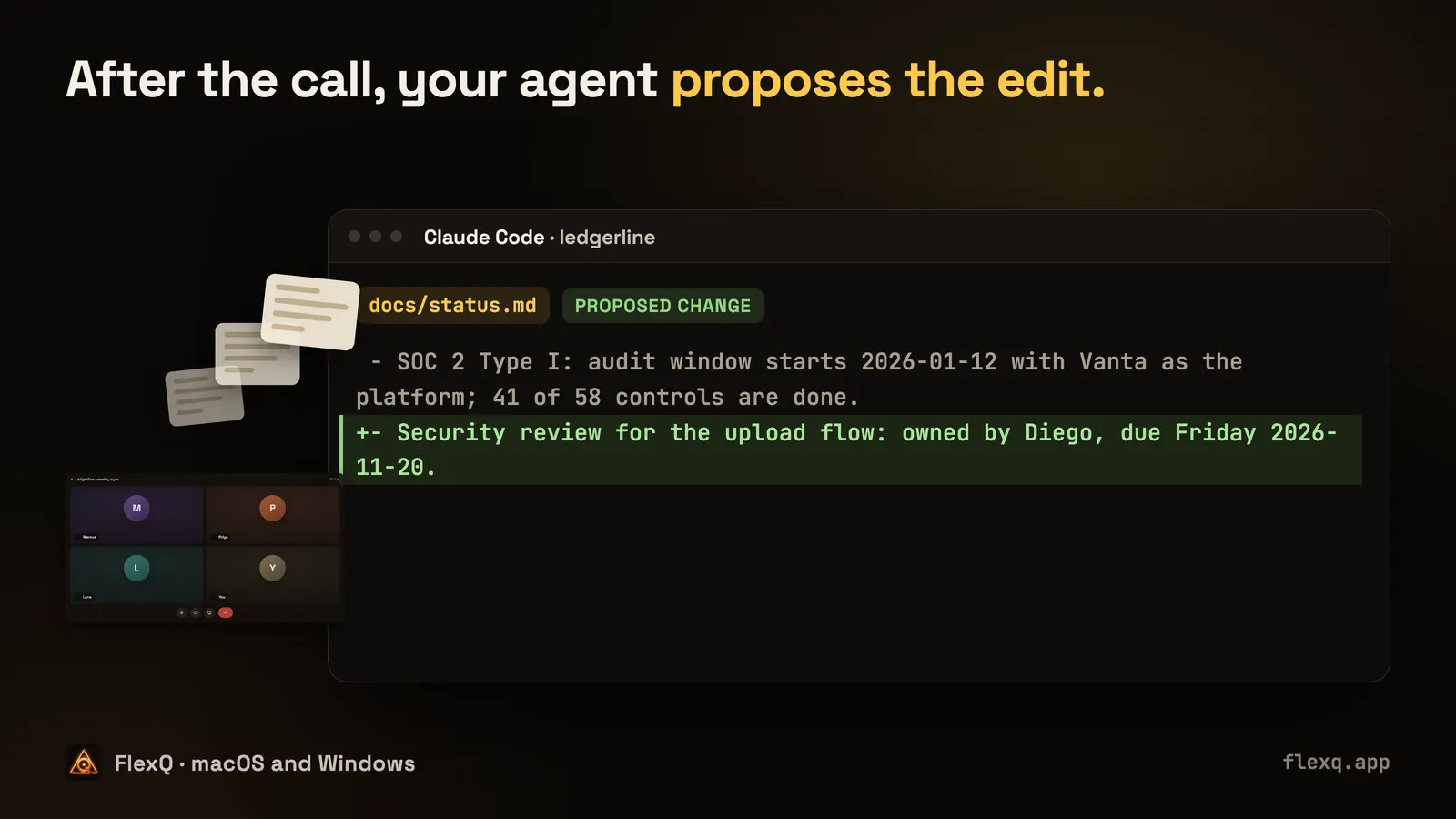
If your team keeps architecture decision records, the debrief is also where a call decision becomes a new ADR or an update to an old one. Have the agent propose those changes to the tracked documents as one diff for you to approve, never as a silent edit.
Using it live on a call
A facts file already helps if you skim it before a call. FlexQ, an AI meeting assistant for macOS and Windows, uses it during the call. You point FlexQ at the project folder, and its Prepare step gives your coding agent an instruction like the one above, which writes .flexq/context/00-facts.md in the project. On the call, FlexQ listens on your computer, and when someone asks you a question it shows a short cue from those files on your screen. You answer in your own words. After the call, its Debrief step hands the call to your agent, which proposes doc changes as a diff for you to approve. FlexQ was tested with Claude Code and Codex. How it handles your files is set out in the privacy policy.
Download FlexQ for macOS or Windows.
FAQ
What should go in CLAUDE.md vs a facts file?
CLAUDE.md or AGENTS.md tells the agent how to work in the repository; a facts file records what is true about the project. Keep commands, conventions and rules in CLAUDE.md or AGENTS.md. Put exact values, dates, owners, endpoints and decisions with their reasons in the facts file, one fact per line with its source, and point to it from CLAUDE.md in one line.
How do I keep CLAUDE.md or AGENTS.md up to date after calls?
After each call, give the agent the call notes and ask it to propose changes to the tracked documents as a diff that you approve. The agent records decisions and tasks with where they were said, refreshes the facts file, and never edits a tracked document until you say yes.
Can Claude Code write project documentation for meetings?
Yes. Claude Code or Codex can read the repository and write a facts file for meetings, if you give it strict rules: copy values verbatim, never round, cite a source on every line, keep conflicting sources side by side and mark values that exist only in code. Then read the result once yourself before the call.
How long should a project facts file be?
Small enough to skim in a minute. Keep the facts most likely to come up on a call in the main file and move the rest to a reference file in the same format. A long file is read less, by you and by any tool that has to fit it into a prompt.
How do I keep secrets out of agent context files?
Tell the agent never to write credentials, tokens, keys or passwords into context files, keep secret files out of Git, and name where a secret lives instead of its value. Tools that read these files should also skip anything that looks like a secret: FlexQ skips files excluded by .gitignore and files that look like secrets, such as .env files, keys and credentials.
More
AI meeting assistant for work calls · All guides · Download FlexQ